
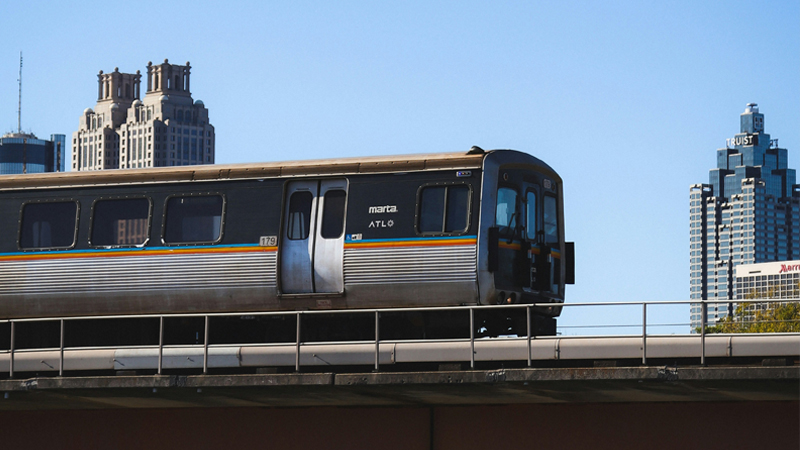
MARTA transported approximately 4.7 million rail passengers during Atlanta’s 2026 FIFA World Cup events. Although MARTA reported no major crimes during the tournament, other recent incidents demonstrate how passengers and members of the public may be injured.
On July 7, 2026, a fleeing driver crashed into a MARTA bus in northwest Atlanta, sending five people, including the operator, to a hospital. In June, a mechanical failure disabled a train near Lenox Station for more than an hour. MARTA’s security practices also came under federal review following violent incidents on trains and at stations.
These incidents do not automatically establish MARTA’s liability. A successful claim requires evidence that MARTA or another party was negligent and that the negligence caused the injury.
The Atlanta personal injury lawyers at Hall & Lampros, LLP can investigate a MARTA accident, identify responsible parties, and determine what compensation may be available. Call our personal injury law firm now at 404-876-8100.
Common MARTA Accident Claims
MARTA-related injuries may result from:
- Bus or train collisions
- Buses striking pedestrians, cyclists, or motorists
- Sudden or violent vehicle movements
- Falls while boarding or exiting
- Doors closing on passengers
- Defective elevators, escalators, or wheelchair lifts
- Slippery floors, broken stairs, or poor lighting
- Dangerous parking-lot conditions
- Poorly maintained vehicles or equipment
- Assaults allegedly connected to inadequate security
Because the cause is not always obvious, attorneys may need to obtain surveillance footage, vehicle data, maintenance records, incident reports, and witness statements.
MARTA Owes Passengers a Heightened Duty
Georgia considers MARTA a common carrier. Under O.C.G.A. § 46-9-132, MARTA must exercise “extraordinary diligence” to protect its passengers. This heightened duty may apply to vehicle operation, equipment maintenance, boarding and exiting, and responses to known dangers.
MARTA is not automatically liable whenever a passenger is injured. For example, in MARTA v. Brown, the Georgia Court of Appeals explained that MARTA does not have to wait until every passenger is seated before moving. Someone injured by an abrupt bus or train movement may need to prove that it was sudden and violent as well as unusual and unnecessary under the circumstances.
MARTA May Not Be the Only Responsible Party
A MARTA accident may involve multiple parties. Depending on the facts, a claim could potentially be brought against:
- MARTA
- Another negligent driver
- A commercial driver’s employer
- A maintenance contractor
- A vehicle or equipment manufacturer
- Another government entity
- An uninsured or underinsured motorist insurer
The July 2026 bus collision, for example, reportedly began with a fleeing driver. MARTA’s involvement alone does not mean MARTA caused the crash. An attorney must investigate everyone whose conduct contributed to the accident and identify every available insurance policy.
Can You Sue MARTA?
Yes. Although MARTA is a public authority, Section 22 of the MARTA Act waives its governmental immunity from tort liability. Georgia courts have explained that MARTA may be held liable in tort much like a private corporation.
MARTA is not treated as a typical state agency under the Georgia Tort Claims Act. Therefore, that Act’s 12-month state notice requirement, 90-day waiting period, and $1 million-per-person and $3 million-per-occurrence limits do not automatically govern MARTA accident claims.
MARTA has its own Risk Management Department for accident and injury claims. However, reporting an accident does not take the place of filing a lawsuit or completing any other legal requirement.
How Long Do You Have to File?
Georgia’s general statute of limitations usually gives an injured person two years from the date of an accident to file a personal injury lawsuit. A lawsuit against MARTA must generally be filed in the State Court or Superior Court of Fulton County.
Different rules may apply when a case also involves the City of Atlanta, a county, or a Georgia state agency. For example, a claim against the City of Atlanta generally requires written notice within six months. Sending notice to the wrong entity may not protect a claim against the correct one.
You should not wait until the deadline approaches. Surveillance footage, onboard recordings, vehicle data, and maintenance records can be lost or overwritten. An attorney can promptly request that this evidence be preserved.
Georgia’s Updated Negligent-Security Law
Georgia Senate Bill 68, signed into law on April 21, 2025, changed the standards for claims involving criminal acts on another party’s property. These changes may affect someone injured in an assault at a MARTA station, parking lot, train, or other facility.
Courts may examine MARTA’s security measures, its knowledge of a specific danger, similar previous incidents, whether additional precautions were practical, and whether those precautions could have prevented the attack.
This issue is especially relevant after the Federal Transit Administration opened a review of MARTA’s security spending and safety protocols in June 2026. MARTA responded that crime was down compared with 2025 and cited additional officers, train patrols, upgraded fare gates, and its Real Time Crime Center.
The federal review does not prove liability in any particular case, but earlier incidents, security records, and internal reports may be relevant evidence.
What Compensation May Be Available?
Depending on the injuries and available evidence, compensation may include:
- Medical expenses
- Lost income
- Reduced earning capacity
- Pain and suffering
- Disability or disfigurement
- Rehabilitation expenses
- Property damage
- Wrongful death damages
The Georgia Tort Claims Act’s damages caps do not automatically apply to MARTA. However, the Georgia Supreme Court has held that punitive damages generally cannot be recovered against the authority.
What Should You Do After a MARTA Accident?
Seek medical treatment and immediately report the incident to the operator, a station employee, or MARTA Police. Record the bus or train-car number, route, station, time, and direction of travel. Photograph the scene, obtain witness information, save your Breeze transaction history, and request the incident-report number. Avoid signing a release or giving an extensive recorded statement before speaking with an attorney.
Contact a MARTA Accident Lawyer in Georgia
MARTA claims may involve common-carrier law, premises liability, negligent security, and multiple insurance policies. The Atlanta personal injury lawyers at Hall & Lampros, LLP can preserve evidence, identify responsible parties, and pursue the compensation available under Georgia law.
Call 404-876-8100 or contact us online for a free initial consultation. There is no attorney’s fee unless we recover compensation for you.



















 ES
ES